
The Death of a Hero
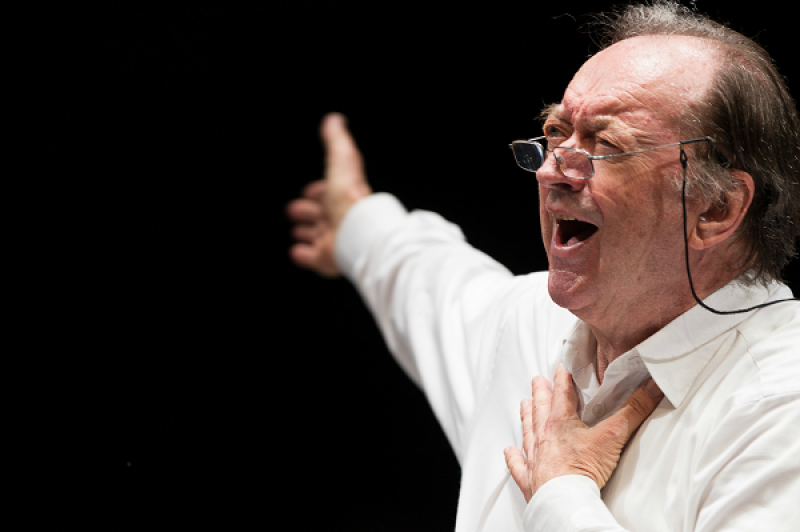
I had just returned to the hotel in Seoul after a concert of Schubert Symphonies with my colleagues of Les Musiciens du Louvre and was entering the elevator to leave my instrument in my room when Mr. Minkowski takes me aside by my arm and says with halting words “…Harnoncourt is dead”. Shocked, but not surprised as I had heard that his health was worse than usual and that his days were coming to an end. The thing is that one is never prepared for the death of a close friend, relative, parent, or hero (from Greek ἥρως hērōs, “hero”: literally “protector” or “defender”) – for he was very much a hero.
He founded his ensemble Concentus Musicus Wien in 1953. For many, it was simply an orchestra playing on “historical” instruments with appropriate historical performance practices, but I always considered Concentus to be a sort of laboratory – a laboratory studying human expression through the ages, and that experiment was led by Harnoncourt for sixty-three years. Together, their experiments produced a wide variety of recordings from all musical periods from the Baroque (roughly 1685-1750) to the Romantic (roughly 1800-1910) beginning with the viol music of Henry Purcell, and extending to include works like Bach’s The Musical Offering, Monteverdi’s L’incoronazione di Poppea, and Rameau’s Castor et Pollux. One of his final recordings with the Concentus Musicus Wien was of Beethoven’s Symphonies Nos. 4 and 5.
Historical performance – an approach to classical music that aims to be faithful to the manner and style of the era in which a work was originally conceived. Performance on period instruments is one element of this discipline; others include attention to original conventions, ornamentation, tuning, and the social setting in which a work was first heard.
Some of the results of this experimentation were published in his two main books, Baroque Music Today: Music As Speech and The Musical Dialogue: Thoughts on Monteverdi, Bach, and Mozart, and they were extremely influential for me.
But his experiments were not conducted simply with his own ensemble, he came to be revered by the musical world and was very much in demand to conduct programs with the preëminent modern orchestras such as the Amsterdam Concertgebouworkest, the Berliner Philharmoniker, or the Wiener Phlharmoniker.
His approach empowered many of the later pioneers such as Sigiswald Kuijken and Reinhard Goebel, and forever changed the way we hear works from the early Middle Ages up until the Expressionist movement of the early 1900s.
From the Guardian’s obituary:
Harnoncourt’s long career coincided with radical developments in the performance of music of all eras. During this period, early music became more established and the distinction between historical and mainstream gradually faded. Harnoncourt was at the centre of this transformation. His career also coincided with the demise of the conductor as feared tyrant. To the end of his life he remained fundamentally opposed to the cult of the autocratic conductor – the only man he acknowledged as “maestro” was his hairdresser, he joked. His rehearsal process was collegiate, with musicians as partners.
The Hero is dead, but not forgotten.
Alles Gut.
Sources
- Nikolaus Harnoncourt. Baroque Music Today: Music As Speech. (1988.)
- ———. The Musical Dialogue: Thoughts on Monteverdi, Bach, and Mozart. (1997.)